

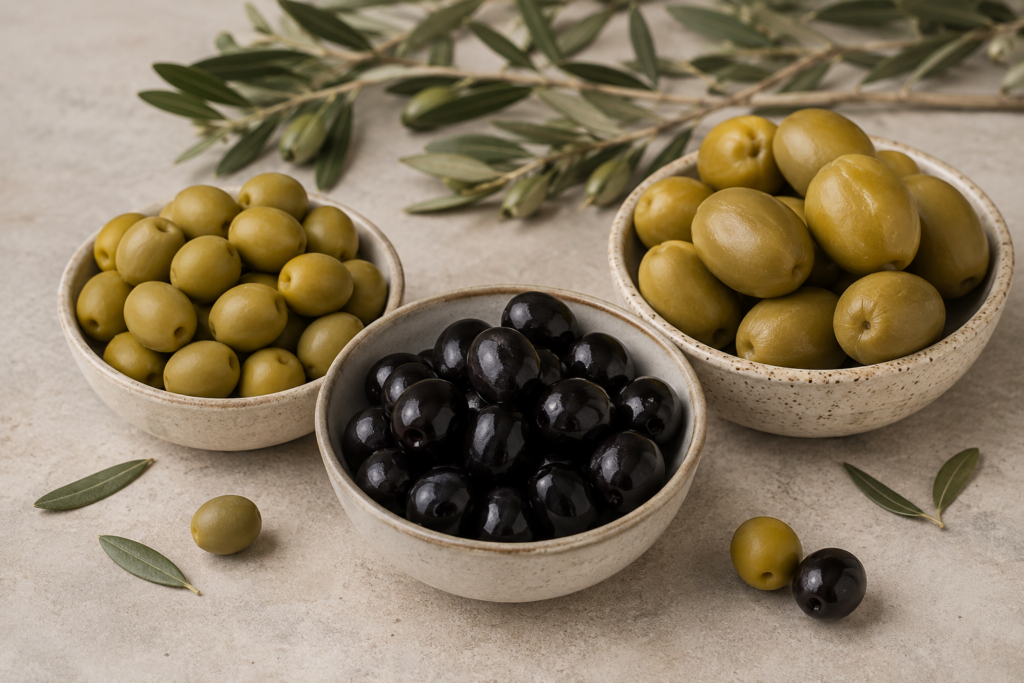
How olive variety influences flavor, texture and presentation

Choosing an olive is not simply a matter of choosing between green and black. The variety directly influences characteristics consumers notice from the very first bite: flavor, flesh firmness, fruit size and appearance. It also determines which presentations are most suitable, from whole olives to pitted, stuffed or sliced olives.

In Spain, Hojiblanca, Manzanilla and Gordal are among the most representative table olive varieties. Each has its own distinctive profile and therefore responds differently to consumer expectations and the needs of each sales channel.

Three varieties, three ways to enjoy olives

Manzanilla stands out for its balance. Its moderate size, good flesh-to-pit ratio and firm yet pleasant texture make it particularly well suited as a table olive. Its flavor profile is mild and delicate, which contributes to its popularity in appetizers and products where versatility is essential.

Hojiblanca offers a different character. It has firm flesh and a balanced flavor profile with subtle bitter notes. Its consistency allows it to adapt to different preparations and formats, both as a green olive and in black olive preparations. It is particularly interesting when the aim is to combine distinctive character on the palate with consistency and commercial versatility.

Gordal is instantly recognizable. Its large size and high proportion of flesh give it a distinctive presence, while its meaty texture provides a more substantial eating experience. These characteristics make it particularly attractive for whole and stuffed presentations, where visual appearance forms part of the product’s value.

Variety is only the beginning

However, variety does not act alone. The degree of ripeness, the origin of the fruit and processes such as cooking, fermentation, selection or size grading also influence the final sensory profile. Different studies have confirmed that the cultivar and growing area affect attributes such as bitterness, acidity, saltiness, firmness and astringency.

For this reason, selecting an olive variety is also a commercial decision. The right product will depend on the market, the format, the recipe and the experience you want to offer consumers.

At Hutesa, we work with Hojiblanca, Manzanilla and Gordal, applying specific expertise to each variety and carefully managing the process to bring out the best in their flavor, texture and appearance, adapting them to each customer’s needs.

More news

Fermentable protective coatings to reduce mechanical damage in green table olives
R&D project that has received financial support from the CDTI through the European Union’s European Regional Development Fund (ERDF): Spain’s Multi-Regional Operational Programme 2021-2027.

HUTESA AGROALIMENTARIA, S.A. has opted to make use of plant by-products from olive groves to formulate new coatings that protect Hojiblanca green table olives against bruising. The project characterises and extracts structural compounds, develops prototype coatings and studies the associated microbiology to integrate them into the fermentation process. Finally, their effects on agronomic parameters, olive quality and product shelf life are assessed through field trials and pilot-scale fermentations.

Objective: To develop new protective coatings that reduce bruising and improve the fermentation of green table olives.
Project location: Fuente de Piedra (Málaga).
Implementation period: From 15 April 2025 to 14 April 2028.
Total approved budget: €732,304.67.

CDTI and ERDF co-financing
This grant is co-financed by the European Regional Development Fund (ERDF) through Spain’s Multi-Regional Operational Programme 2021-2027.

New biotechnological strategies for reducing acrylamide in black olives
R&D project that has received financial support from the CDTI through the European Union’s European Regional Development Fund (ERDF): Spain’s Multi-Regional Operational Programme 2021-2027.

HUTESA AGROALIMENTARIA, S.A. has opted to develop biotechnological strategies to reduce acrylamide in black olives. It uses indigenous microorganisms and antioxidants derived from olive tree by-products, validating their effectiveness and feasibility on a pilot scale.

Objective: To reduce acrylamide levels in black olives by applying enzymes derived from microbial sources.
Project location: Fuente de Piedra (Málaga).
Implementation period: From 15 October 2025 to 14 October 2028.
Total approved budget: €612,246.00.

CDTI and ERDF co-financing
This grant is co-financed by the European Regional Development Fund (ERDF) through Spain’s Multi-Regional Operational Programme 2021-2027.

New olive stone oil production line
Investment project that has received financial support from the CDTI through the European Union’s European Regional Development Fund (ERDF): Spain’s Multi-Regional Operational Programme 2021-2027.

HUTESA AGROALIMENTARIA, S.A. has opted to fully modernise and automate its olive stone processing and olive oil extraction line. To this end, it incorporates specialised equipment (mill, malaxer, decanter and centrifuge) that maximises yield, product uniformity and quality. It also integrates an ozone disinfection system and centralised control using PLC and HMI, ensuring hygiene, operational safety and real-time monitoring of the entire process.

Objective: To diversify production through the acquisition of a new olive stone oil extraction line.
Project location: Fuente de Piedra (Málaga).
Implementation period: From 8 September 2025 to 10 November 2026.
Total approved budget: €628,071.00.

CDTI and ERDF co-financing
This grant is co-financed by the European Regional Development Fund (ERDF) through Spain’s Multi-Regional Operational Programme 2021-2027.

Please send us your CV: