

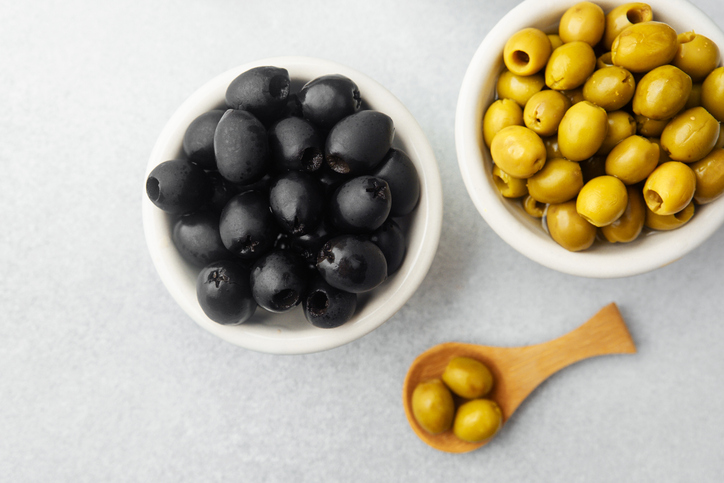
Differences between green, black and stuffed olives

At first glance, the difference between a green olive, a black olive and a stuffed olive may seem to lie only in their colour or presentation. However, behind each one there is a specific harvesting stage, a production process and a different way to enjoy this fruit, so closely linked to the Mediterranean diet.

Green olives are harvested before the fruit begins to change colour, once it has reached its normal size but while the flesh is still firm. This firmness is one of their main advantages: it allows the olive to be handled properly during the curing, pitting or stuffing process, while helping to maintain a pleasant texture on the palate.

Black olives are not olives that are picked black from the tree, but green olives that acquire this colour through a controlled process of oxidation. During this preparation, the olives are subjected to specific conditions that gradually darken the fruit until it reaches its characteristic black colour. The product is then stabilised through suitable preservation treatments to ensure food safety and maintain its qualities until consumption.

Olives naturally have an intense bitterness, which is why they need to go through a preparation process before reaching the consumer. Depending on the type of olive and the desired result, this may involve stages such as washing, treatment to reduce bitterness, fermentation in brine, selection, grading, packaging and thermal preservation treatments.

And what about stuffed olives? In reality, they are not a category defined by colour, but by presentation. They are pitted olives filled with an edible ingredient, such as pepper, almond, garlic or other fillings. Green olives are the most commonly used for stuffing because their firm texture makes pitting easier, withstands handling better and offers a balanced contrast between the flavour of the olive and that of the filling.

For this reason, rather than talking about one olive being “better” than another, it is more appropriate to talk about uses, tastes and moments of consumption. Green olives stand out for their firmness and versatility; black olives for their mild flavour, uniform colour and presence in recipes, salads and appetisers; and stuffed olives for bringing variety, flavour and convenience to every bite.

At Hutesa, understanding each type of olive and controlling every stage of the process is key to offering a product with the right balance of flavour, texture, safety and quality.

More news

Fermentable protective coatings to reduce mechanical damage in green table olives
R&D project that has received financial support from the CDTI through the European Union’s European Regional Development Fund (ERDF): Spain’s Multi-Regional Operational Programme 2021-2027.

HUTESA AGROALIMENTARIA, S.A. has opted to make use of plant by-products from olive groves to formulate new coatings that protect Hojiblanca green table olives against bruising. The project characterises and extracts structural compounds, develops prototype coatings and studies the associated microbiology to integrate them into the fermentation process. Finally, their effects on agronomic parameters, olive quality and product shelf life are assessed through field trials and pilot-scale fermentations.

Objective: To develop new protective coatings that reduce bruising and improve the fermentation of green table olives.
Project location: Fuente de Piedra (Málaga).
Implementation period: From 15 April 2025 to 14 April 2028.
Total approved budget: €732,304.67.

CDTI and ERDF co-financing
This grant is co-financed by the European Regional Development Fund (ERDF) through Spain’s Multi-Regional Operational Programme 2021-2027.

New biotechnological strategies for reducing acrylamide in black olives
R&D project that has received financial support from the CDTI through the European Union’s European Regional Development Fund (ERDF): Spain’s Multi-Regional Operational Programme 2021-2027.

HUTESA AGROALIMENTARIA, S.A. has opted to develop biotechnological strategies to reduce acrylamide in black olives. It uses indigenous microorganisms and antioxidants derived from olive tree by-products, validating their effectiveness and feasibility on a pilot scale.

Objective: To reduce acrylamide levels in black olives by applying enzymes derived from microbial sources.
Project location: Fuente de Piedra (Málaga).
Implementation period: From 15 October 2025 to 14 October 2028.
Total approved budget: €612,246.00.

CDTI and ERDF co-financing
This grant is co-financed by the European Regional Development Fund (ERDF) through Spain’s Multi-Regional Operational Programme 2021-2027.

New olive stone oil production line
Investment project that has received financial support from the CDTI through the European Union’s European Regional Development Fund (ERDF): Spain’s Multi-Regional Operational Programme 2021-2027.

HUTESA AGROALIMENTARIA, S.A. has opted to fully modernise and automate its olive stone processing and olive oil extraction line. To this end, it incorporates specialised equipment (mill, malaxer, decanter and centrifuge) that maximises yield, product uniformity and quality. It also integrates an ozone disinfection system and centralised control using PLC and HMI, ensuring hygiene, operational safety and real-time monitoring of the entire process.

Objective: To diversify production through the acquisition of a new olive stone oil extraction line.
Project location: Fuente de Piedra (Málaga).
Implementation period: From 8 September 2025 to 10 November 2026.
Total approved budget: €628,071.00.

CDTI and ERDF co-financing
This grant is co-financed by the European Regional Development Fund (ERDF) through Spain’s Multi-Regional Operational Programme 2021-2027.

Please send us your CV: